
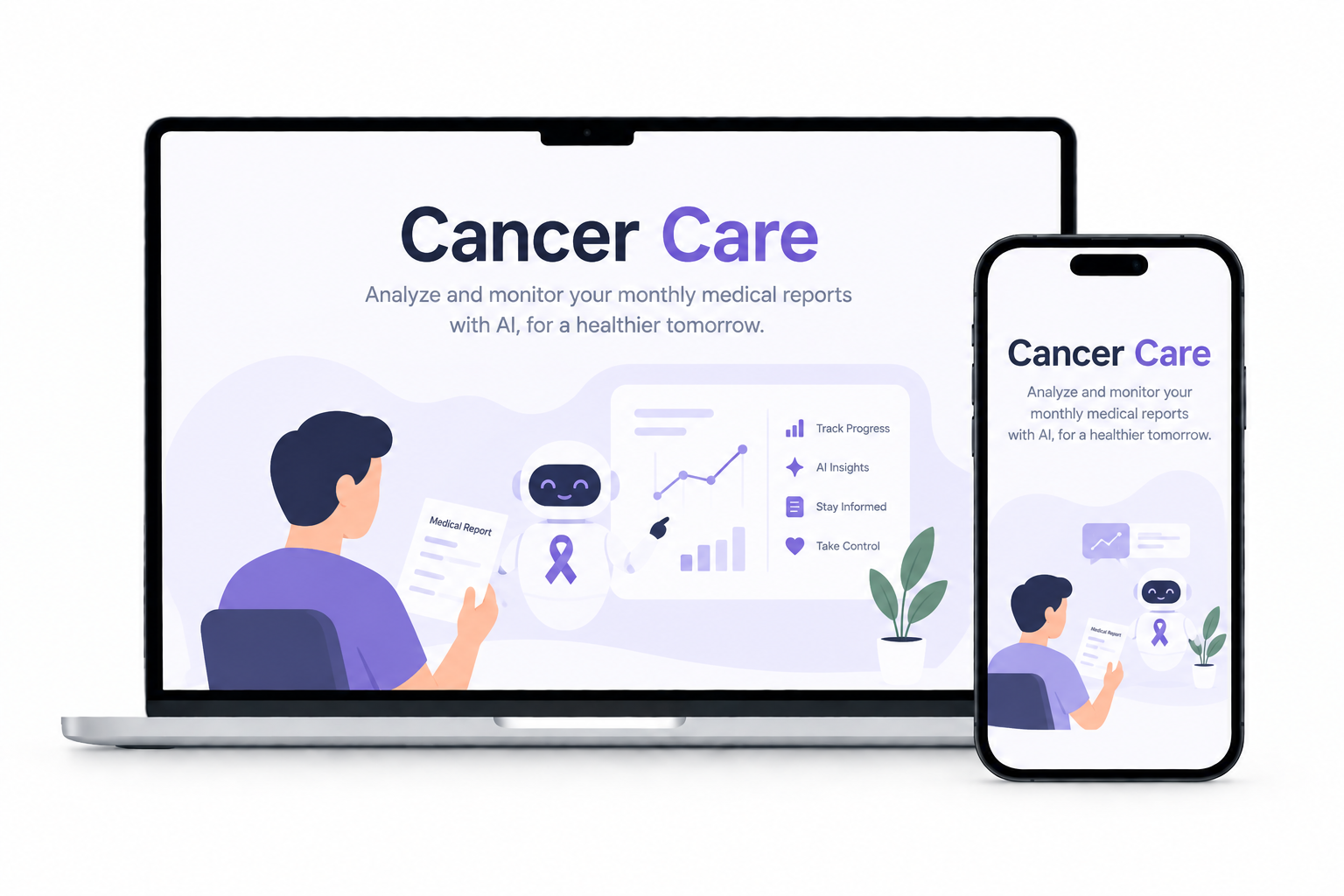
Cancer Care
Monthly medical reports, read and monitored with AI.
Cancer Care takes a monthly medical report and tells the person holding it what changed. That sentence is the whole product, and everything difficult about building it sits inside it. Reports do not arrive in one standard shape, and the person reading the output is usually not a clinician.

An AI that is confidently wrong about a medical report is worse than no AI at all.
So the question worth arguing about is not how clever the model is. It is what the product does when it is unsure. Saying nothing, saying so plainly, or pointing the person at a doctor are all better answers than a confident guess.
Deciding that before the build starts is cheap. Deciding it after someone has acted on an output is not a decision any more, it is an incident.
Where health is involved, the product’s job is to be legible, not impressive.
The problem
A monthly report is a page of numbers with reference ranges printed beside them. It tells you whether each value sits inside a band. It does not tell you whether this month is better or worse than last month, which is the only question the person holding it is actually asking.
They take that question to whoever is nearest, and often that is a search engine rather than a doctor.
What it has to get right
Reading a value is the easy half. The hard half is describing what changed since last time, in language that does not frighten someone who is already frightened, and knowing when the right answer is to say nothing at all.
The safest output is very often the shortest one.
Where this goes next
Nothing here is finished. The decision that matters most has not been made yet, and it is not a technical one: where the product stops and a clinician starts, written down in plain words, before anyone builds further.
Conclusion
This write-up is short because the build is young. What it needs before launch is a plain line about what the product does not do, written down and checked by someone qualified to check it.